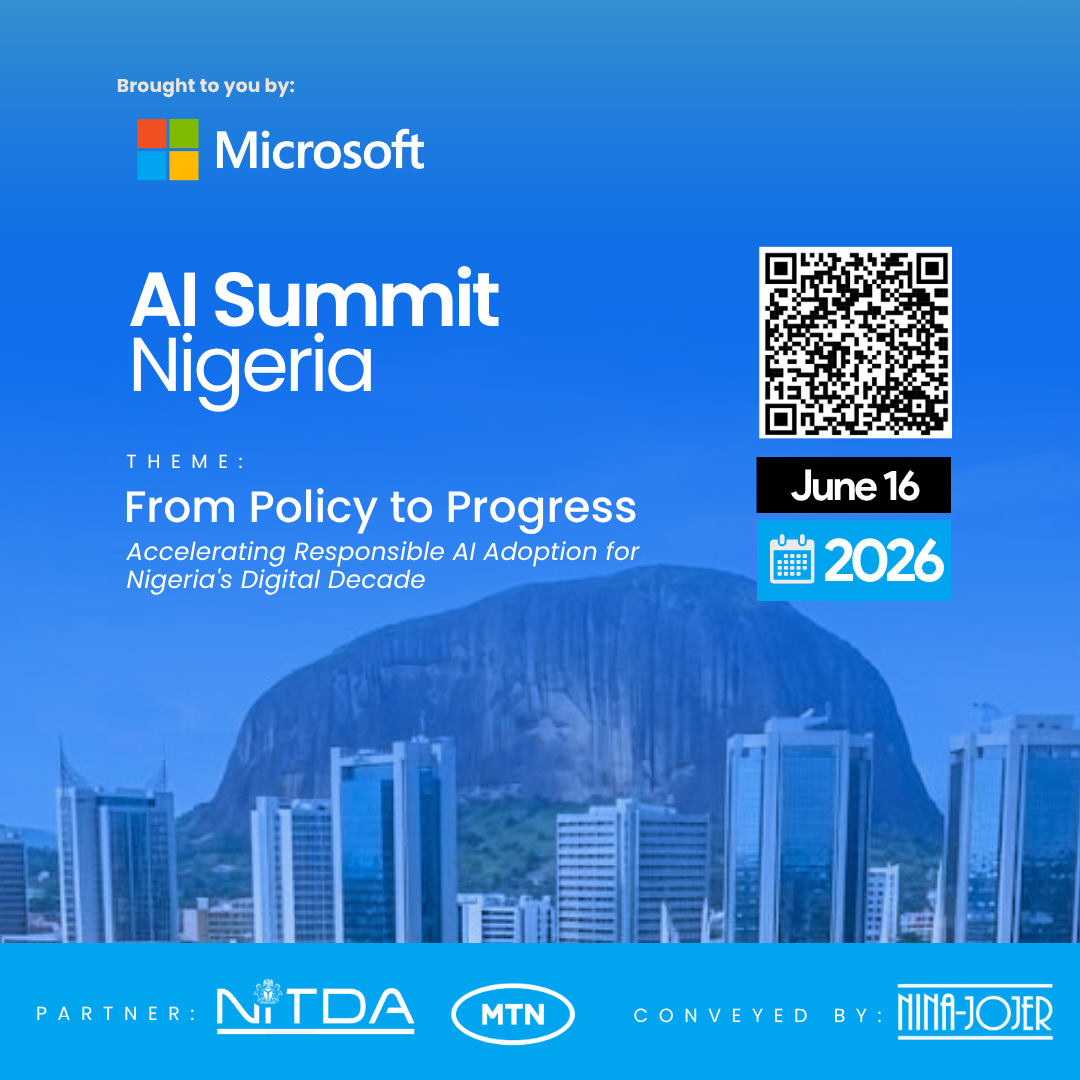
AI SUMMIT NIGERIA

From Policy to Progress: Accelerating Responsible AI Adoption for Nigeria's

Save my spot
Date2026-06-16
LocationTranscorp Hilton, Abuja
Time8:00 am
CategoryArtificial Intelligence
AI SUMMIT NIGERIA

Background

Nigeria has built a strong policy foundation for AI:

National Artificial Intelligence Strategy (NAIS): Launched September 2025 after co-creation with over 120 AI researchers and practitioners. Features a clear five-pillar framework (infrastructure, ecosystem development, sector adoption, responsible AI, and governance).

N-ATLAS (Nigerian Atlas for Languages & AI at Scale): Launched in 2025 — an open-source, multilingual large language model for Nigeria’s major languages (Hausa, Igbo, Yoruba, and English). One of Africa’s earliest government-backed national-scale AI models.

National Digital Economy and E-Governance Bill 2025: Currently before the National Assembly. Would provide statutory force through:

Legal certainty for electronic transactions

Mandatory national skills framework

Regulatory sandbox for AI innovation

Nigeria Data Exchange platform for secure inter-agency data sharing

Global Ranking: Nigeria now ranks among the top 60 countries globally on AI readiness (UN assessments).

Current Challenge: Moving from policy to execution. Key obstacles include:

Fragmented data environments

Unclear accountability frameworks

Significant compute and skills gaps in the civil service

Governance not yet aligned with technology

Lack of independent government visibility into large parts of the economy (strategic data held by global digital platforms)

Digital creative economy largely unmeasured in national accounts

Proof of Concept: NINA JOJER Africa, with ACET, IDRC, and Federal Ministry of Communications, Innovation and Digital Economy, ran an AI hackathon in November 2025 that produced three functional prototypes for economic intelligence.

Why This Summit, and Why Now

Nigeria has significant AI activity and broad literacy programmes, but lacks a structured, high-level forum for government decision-makers focused on implementation.

Focus: The layer between skilling and procurement — governance, infrastructure, and accountability.

Goal: Move from AI policy to responsible AI deployment that maintains public trust and Nigerian control.

Supports Nigeria’s ambition to shift from AI consumer to AI producer.

Nigeria's Current Position and Plans

Key initiatives forming the foundation:

NAIS (Sept 2025): Recommends National AI Steering Committee, National AI Ethics Commission, and technical secretariat in NITDA and NCAIR.

N-ATLAS (Sept 2025 at UNGA): Trained on 400 million tokens of local-language data — continent’s first sovereign model at this scale.

National Digital Economy and E-Governance Bill 2025: Key sections include:

Section 46: Nigeria Data Exchange

Section 74: Regulatory sandbox

Section 56: Mandatory National Digital Skills Development Framework

Section 80: Grants, tax reliefs, and Nigeria First procurement policy

National AI Collective (NAICI): Community of practice for ethics and safety.

Developers in Government (DevslnGov) and Three Million Technical Talent (3MTT): Building public sector capacity.

Nigeria Data Protection Act 2023: Legal foundation for data governance.

Remaining Gap: Operationalisation inside MDAs — risk assessment, data classification, accountability, and building public trust.

Core Themes

1. Making the Rules Work: Regulatory Clarity for Government AI

Addresses lack of coherence at implementation level.

Sector-specific compliance pathways (health, finance, public administration) still undefined.

Focus on translating the 2025 Bill’s provisions into practical governance for MDAs.

Summit will produce practical recommendations for the AI Steering Committee and Ethics Commission.

2. What Does Digital Sovereignty Actually Mean for Nigeria?

Honest discussion on sovereignty given constraints (limited compute, strained power infrastructure, uneven internet access).

Explores practical options balancing innovation with oversight and control.

Includes data classification and real-world implications for Nigeria and West Africa.

3. From Pilots to Practice: AI in Government Services

Moves from theory to demonstration using validated use cases.

Sources: Peer-country governments, AI for Good, and NINA JOJER/ACET/FMCIDE project prototypes.

Workshop format to identify adoptable use cases (revenue collection, citizen services, regulatory monitoring, etc.).

Goal: Match use cases to MDAs with partner support and institutional oversight from NITDA and NCAIR.

Expected Outcomes

The summit aims to deliver three concrete outputs:

Policy Communiqué

Nigeria’s AI priorities for public sector adoption (2026–2027), aligned with the 2025 Bill, to be submitted to the National AI Steering Committee.

Government AI Deployment Framework

Practical guide for MDAs covering best practices, data governance, accountability standards, and adoption pathways.

Identified AI Pilots for MDA Adoption

Specific use cases matched to MDAs, with private sector partners and scaling pathways under NITDA/NCAIR oversight.

Save my spot

Ready to move forward?

Let us help you navigate what comes next

Let's Talk