
Turning Talk into Transit: Why Africa’s Strategic Corridors Must Lead the Next Phase of Continental Development
ADDIS ABABA - At the 39th African Union Summit in Addis Ababa, an event convened by the Corporate Council on Africa (CCA) alongside the U.S. State Department signalled an overdue shift in Africa’s development discourse: from abstract ambition to pragmatic action.

18th Feb. 2026, 11:45 AM .
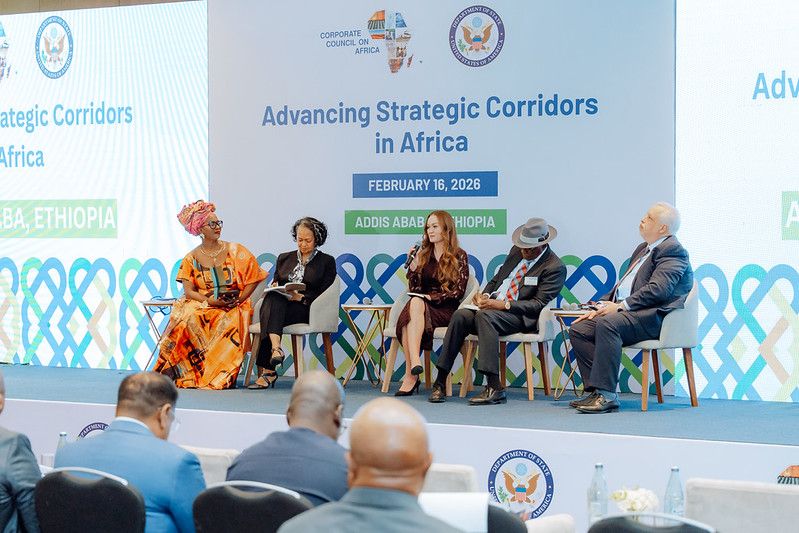
ADDIS ABABA - At the 39th African Union Summit in Addis Ababa, an event convened by the Corporate Council on Africa (CCA) alongside the U.S. State Department signalled an overdue shift in Africa’s development discourse: from abstract ambition to pragmatic action. The subject was strategic corridors—transport, logistics, energy and digital networks that stitch markets, producers and consumers across 55 nations. But the rhetoric revealed as much about Africa’s opportunities as its enduring bottlenecks.
For decades, African leaders have rightly decried fragmented planning and investment frameworks. Yet the persistent fragmentation that slows projects, escalates costs, and deters long-term investors now confronts a geopolitical context in which the continent’s mineral endowments and demographic dynamism make it too important to ignore.
Africa is home to the bulk of the world’s critical mineral reserves. The Democratic Republic of Congo holds about 70 percent of global cobalt; South Africa produces roughly 90 percent of world platinum. These minerals are foundational to electric vehicles, renewable energy systems, advanced manufacturing and digital technologies. In African Finance Corporation's recent report, Compendium of Africa’s Strategic Minerals, Africa hosts one of the world’s most diversified and strategically significant mineral endowments, with an estimated US$29.5 trillion in mine-site value – approximately 20% of the global total. Of this, US$8.6 trillion remains undeveloped, equivalent to roughly 2.5 times the continent’s annual GDP
But riches beneath the soil are not prosperity above it. As the CCA repeatedly emphasised, the global competitiveness of critical mineral sectors—or any integrated industrial system—is determined not just by extraction, but by the multimodal infrastructure that connects production centres to processing facilities and ports. Rail, road, energy, logistics hubs, digital connectivity and industrial parks are not merely “projects”; they are the circulatory system of a functioning economy.
Herein lies the paradox. Africa’s political leadership recognises the imperative of economic integration—from Agenda 2063 to the African Continental Free Trade Area (AfCFTA). Yet implementation is conditioned by the very fragmentation that undermines that vision. Delays of 18–36 months, cost overruns of 40–60 percent, and misaligned regulatory frameworks are not anomalies—they are the expected outcome of siloed planning and weak cross-border coordination.
Conversely, well-executed corridors transform investability. Comprehensive planning that harmonises transport, energy and digital networks turns a patchwork of isolated projects into an integrated economic ecosystem. Under such systems, risk premiums fall, institutional investors move from cautious to committed, and long-term capital—both African and foreign—can be mobilised at scale.
That is why the creation of the U.S.–AU Strategic Infrastructure and Investment Working Group—announced on the heels of Deputy Secretary of State visits—is both timely and strategic. Its stated purpose is to identify, prioritise and advance bankable projects with strong commercial prospects, political backing, strategic relevance and alignment with continental priorities. If done right, this platform could be a bridge between high-level diplomacy and real-world implementation.
But making that transition is easier said than done.
One telling theme in the summit’s discussions was the need for projects that are transaction-ready, not just conceptually appealing. The continent has no shortage of visionary lists—the AU alone has identified dozens of priority infrastructure efforts spanning transport, energy, and digital integration—but few are prepared for financing, legal structuring and execution. Investors do not fund ideals; they finance prepared projects with clear regulatory frameworks, predictable returns, and enforceable governance.
This is why corridor development must be anchored in robust institutional frameworks. Projects like the Northern Corridor in East Africa or the Lobito Corridor linking the Angolan coast to Zambia and the DRC succeed not simply because of their length or ambition, but because they have defined operational oversight and day-to-day governance structures that manage cross-border regulation, customs, scheduling, and dispute resolution. Without such mechanisms, corridor planning risks repeating the well-worn pattern of politics without performance.
A second issue is capital mobilisation. Africa has large pools of domestic capital—pension funds, sovereign funds, future bond issues—but these are underutilised. External financing remains dominant, but foreign capital (whether from the U.S., Europe or China) comes with its own strategic conditions and geopolitical baggage. The Chinese model—where state-backed finance, state guarantees and long-tenor commitments underwrite project risk—has succeeded precisely because it confronts risk head-on rather than sidestepping it.
For U.S. partners and African stakeholders alike, the challenge is to craft comparable structures that reassure investors and align incentives. Patient capital—longer tenor, credible guarantees, insurance backstops, and blended finance instruments—is needed to bridge the gap between concept and construction. This is not charity; it is smart economics. Projects that lower logistical costs, boost productivity, and enable industrial integration generate returns that benefit both local economies and global partners.
Third, private sector participation must be authentic and deep. For too long, infrastructure projects in Africa have been framed as public works rather than public-private partnerships. Successful corridors leverage private engineering and capital, but that requires clear legal regimes, enforceable contracts, and transparent procurement. The working group must avoid the temptation to treat policy alignment and private engagement as parallel tracks. Integration is the point: regulatory harmonisation must happen in tandem with financial engineering and project preparation.
Critically, corridor development must also be inclusive and sustainable. Infrastructure that cuts across borders will inevitably affect communities, migration patterns, environmental systems, and labour markets. ESG standards must not be afterthoughts; they should be embedded at every stage. If corridors merely facilitate mineral extraction without local beneficiation and skills transfer, they risk entrenching extractive models rather than transforming economies.
The summit’s discussions touched on digital connectivity, energy transmission, and logistics improvements—but these are not sectoral silos. They are co-dependencies. Energy powers ports and factories. Digital networks enable trade platforms and customs automation. Roads and rails carry goods that fuel industrial clusters. Viewing infrastructure as an integrated ecosystem, rather than a collection of individual assets, is essential to unlocking Africa’s potential.
This brings us to the AfCFTA, which aims to knit a market of 1.3 billion people with a combined GDP exceeding $3 trillion. Trade agreements are frameworks; corridors turn frameworks into flow. Without efficient logistics, tariff reduction becomes a theoretical gain. With them, markets open and value chains deepen.
The private sector—African and global—recognises this. But investors need clarity: What does success look like? What regulatory changes will support project viability? Which legal jurisdictions ensure contract enforcement? What are the mechanisms for dispute resolution? How will returns be realised and risks shared? Answering these questions requires more than working group statements. It demands operational blueprints and measurable milestones.
The CCA’s initiative to mobilise U.S. and African capital and expertise is a welcome start. But it must be backed by concrete mechanisms that move projects from spreadsheets to shovels, from boardrooms to building sites. A pilot project—such as a trans-border railway link or a mineral processing hub with integrated logistics—would provide proof of concept and attract further investment.
Africa's minerals, people and markets offer unparalleled opportunities. But turning promise into prosperity requires infrastructure that connects, policies that enable, and capital that commits. Strategic corridors are not just lines on a map; they are arteries of development. If the working group and its partners can translate talk into transit, Africa’s next decade could be defined not by what leaders aspire to do, but by what they deliver.
Share this article



Stay informed
Get our latest thinking delivered to your inbox each month
We respect your inbox. Unsubscribe anytime from any email.